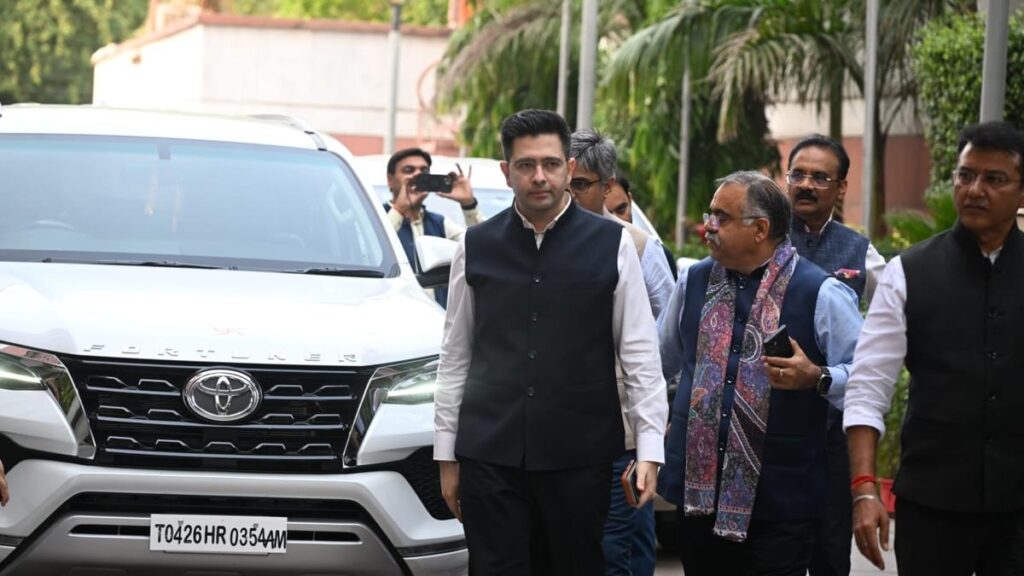
 Raghav Chadha at BJP Headquarters in New Delhi on Friday, April 24, 2026. | Photo Credit: Sushil Kumar Verma
New Delhi: 24 april
Raghav Chadha, a senior Rajya Sabha Member of Parliament from the Aam Aadmi Party (AAP), on Thursday announced that he is quitting the party and joining the Bharatiya Janata Party (BJP), along with a significant number of other AAP MPs in the Upper House.
The development comes as a major political setback for the Aam Aadmi Party and its national convener Arvind Kejriwal, potentially impacting the party’s strength and standing in the Rajya Sabha.
Addressing a press conference in New Delhi, Chadha claimed that nearly two-thirds of AAP’s Rajya Sabha MPs have decided to leave the party and merge with the BJP. He named Swati Maliwal, Harbhajan Singh, Sandeep Pathak, Ashok Mittal, Rajinder Gupta, and Vikram Sahney as MPs who are part of the move.
#WATCH | Delhi: Rajya Sabha MPs Raghav Chadha, Sandeep Pathak and Ashok Mittal join BJP in the presence of BJP National President Nitin Nabin at the party headquarters pic.twitter.com/wcAL8BOr0Z
— ANI (@ANI) April 24, 2026
AAP currently has 10 members in the Rajya Sabha, a majority of whom were elected from Punjab.
“Right Man in the Wrong Party”: Chadha
Speaking to reporters alongside senior MPs Ashok Mittal and Sandeep Pathak, Chadha said he had devoted nearly 15 years of his political life to AAP but felt the party had strayed from the principles of “honest politics” that once defined it.
“The AAP that I gave 15 years of my life to is no longer the same. The party has stepped away from honest politics. I am the right man in the wrong party. I am moving away from the party and going closer to the people,” Chadha said.
He accused the party leadership of abandoning its original anti-corruption ideology that helped it rise to power in Delhi and gain national attention.
Merger Letter Submitted to Rajya Sabha Chairman
Chadha said that the group of MPs has formally submitted documents to the Rajya Sabha Secretariat, invoking constitutional provisions related to party mergers.
“As per the Constitution, two-thirds of the total MPs of a party can merge with another party. We have submitted a letter to Rajya Sabha Chairman C P Radhakrishnan today, along with all the required documents,” he said.
Under the anti-defection law, a Rajya Sabha MP faces immediate disqualification if they resign or switch parties individually. However, the Constitution provides protection if at least two-thirds of a party’s legislators agree to merge with another party.
Political experts say the decision of the Rajya Sabha Chairman will be crucial in determining whether the MPs retain their seats.
Background: Internal
Tensions in AAP
The mass exit follows weeks of reported internal discord within AAP. Raghav Chadha was recently removed as the party’s Deputy Leader in the Rajya Sabha and replaced by Ashok Mittal. Sources had indicated growing differences between Chadha and the party leadership over organisational and strategic issues.
Observers note that this is the first time AAP has faced such a large-scale challenge within Parliament since its emergence as a national political force.
AAP Hits Back, Alleges “Operation Lotus”
Reacting sharply, AAP convened an emergency press conference and accused the BJP of orchestrating the defections as part of what it described as “Operation Lotus”.
“The Bharatiya Janata Party, under the leadership of Narendra Modi and Amit Shah, has launched Operation Lotus. This is cheap politics aimed at destabilising the Aam Aadmi Party and obstructing the good work of the Bhagwant Mann government in Punjab,” an AAP spokesperson said.
The party dismissed Chadha’s allegations and accused the defecting MPs of betraying the public mandate
.
Political Implications
If confirmed and upheld constitutionally, the move could significantly alter AAP’s representation in the Rajya Sabha and mark a major expansion for the BJP in the Upper House. It may also have political repercussions in Punjab, where AAP currently holds power.
Senior BJP leaders have so far refrained from making formal statements, though sources say the party is preparing to welcome the MPs after completion of procedural formalities.
What Happens Next
All eyes are now on the Rajya Sabha Chairman’s office, which will examine the documents submitted by the MPs. The decision will determine whether the merger meets constitutional requirements or triggers disqualification proceedings.
The development is expected to dominate parliamentary and political discourse in the coming days