
France is facing one of its most severe early-summer heatwaves in decades, with deadly consequences already unfolding across the country. At least 40 people have drowned since the weekend while attempting to cool off in rivers, canals, and other unsupervised waterways, French authorities confirmed on Tuesday. The deaths come as temperatures soar close to historic highs, pushing emergency services, transport networks, schools, and businesses to their limits.
The heatwave is not confined to France. Large parts of Europe, including Britain, Italy, Spain, and Belgium, are also experiencing extreme heat, with several regions recording temperatures that are either close to or exceeding seasonal records. Meteorologists and climate scientists warn that such prolonged and intense heat events are becoming increasingly common as climate change accelerates across the continent.
France Under Red Heat Alert
Much of France has been placed under the highest level of heat alert, known as a red warning, as daytime temperatures climb to around 40 degrees Celsius. In some parts of western France, forecasts suggest temperatures could peak as high as 43°C, levels rarely seen outside the height of summer.
France’s national weather service, Meteo France, said the current conditions are “oppressive and exhausting,” with little respite expected overnight. Sunshine is forecast to dominate across most of the country, trapping heat close to the ground and preventing temperatures from falling to safer levels during the night.
Meteorologists have warned that some of the temperatures expected this week could surpass all previous records, regardless of the time of year. Such extreme heat so early in the summer season has raised alarms among public health officials, particularly for elderly people, children, and those with pre-existing medical conditions.
Rising Death Toll as People Seek Relief from Heat
As temperatures soared, many people sought relief by entering nearby bodies of water. However, authorities say a significant number of drownings occurred in unsupervised or dangerous areas, including canals, rivers, and lakes where currents can be strong and water conditions unpredictable.
French Prime Minister Sebastien Lecornu said that around 40 drownings have been recorded since June 18 and that the deaths were directly linked to the extreme heat conditions. Officials stressed that many of the incidents could have been avoided if safety guidelines had been followed.
French Sports Minister Marina Ferrari urged the public to resist the temptation to swim in unauthorised areas, warning that even strong swimmers can quickly find themselves in trouble due to sudden currents, cold water shock, or hidden obstacles.
Beyond drownings, authorities have also reported other heat-related tragedies. In southeastern France, two young children aged two and four were found unconscious in a parked car outside their home and could not be resuscitated. Prosecutors said the incident highlights the lethal danger of leaving children in vehicles during extreme heat, even for short periods.
Urban Areas Struggle as Nights Offer No Relief
Cities have been particularly affected by the heatwave, as dense construction and limited green spaces contribute to the so-called “urban heat island” effect. In Paris, temperatures remained uncomfortably high overnight, leaving many residents exhausted after sleepless nights in apartments that lack air conditioning.
Commuters travelling to work were seen carrying handheld fans and bottles of water on crowded metro platforms. In some cases, heat-related equipment failures forced train cancellations, including on routes linking Paris with Brussels.
Local authorities in Paris and other cities have attempted to ease the burden by opening cooling centres, extending swimming pool hours, and offering free access to air-conditioned public spaces. In one Paris neighbourhood, the municipality offered free cinema tickets to residents under 25 and over 65, allowing them to escape the heat for a few hours.
Business Activity Slows Amid Extreme Conditions
The heatwave is also taking a toll on the economy. Business leaders say productivity has declined as employers adjust working hours, encourage remote work, or slow operations to protect staff.
Patrick Martin, head of France’s MEDEF employers’ group, said many businesses are operating at reduced capacity. Employers have been urged to provide additional breaks, ensure access to drinking water, and modify workloads for outdoor workers.
Retailers in several cities reported shortages of electric fans and portable cooling units as demand surged. Some construction sites and outdoor markets have temporarily shut down during the hottest parts of the day.
A Heatwave Driven by Unusual Weather Patterns
Meteorologists attribute the extreme conditions to a weather pattern known as an “Omega block,” named for its resemblance to the Greek letter Ω. The pattern involves a large bulge of hot air trapped between two cooler systems, effectively locking high temperatures over the same region for an extended period.
This has resulted in the formation of a “heat dome,” which traps hot air over western and central Europe, allowing temperatures to rise day after day. With little wind or cloud cover to disperse the heat, the system has created ideal conditions for prolonged extreme temperatures.
Experts say such patterns are becoming more frequent and more intense due to global warming, increasing the likelihood of long-lasting heatwaves across Europe.
Heatwave Spreads Across Europe
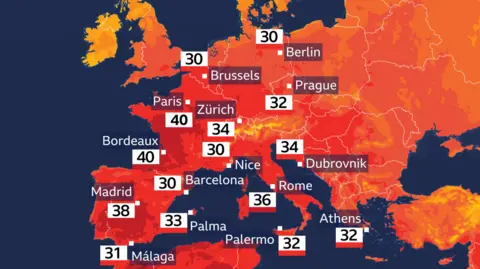
France is not alone in facing extreme heat. Several neighbouring countries are also experiencing dangerous conditions:
Italy
Italy’s health ministry has issued its highest heat alert for 15 cities, including Rome, Florence, and Milan. Authorities have introduced measures to suspend or reduce outdoor work in certain sectors, particularly construction and agriculture. Meteorologists warned that while storms may develop over the Alps and Apennines later in the day, they could bring heavy rain, gusty winds, and hail rather than meaningful cooling.
Britain
Britain is experiencing one of its hottest early summers on record. The national weather service has forecast temperatures of up to 37°C in southern England, with the possibility of setting a new June record. Dozens of schools have announced early closures, citing unsafe classroom conditions in older buildings not designed to cope with extreme heat. Rail operators warned of delays and urged passengers to travel only if necessary during peak heat days.
Spain
Spain’s state meteorological agency has issued red alerts across parts of the country, warning of temperatures reaching 44°C. Some regions have already experienced peaks above 45°C, pushing emergency services to issue repeated health warnings. Overnight temperatures have remained high, with many areas recording minimums above 25°C, offering little relief to residents.
Belgium
In Belgium, the heat has caused unusual disruptions. A primary school in Tervuren, near Brussels, relocated its final exams to a nearby church after classrooms became unbearably hot. Photos shared on social media showed pupils sitting in rows of church chairs, highlighting the extent of the heat’s impact on daily life.
Transport Networks Under Pressure
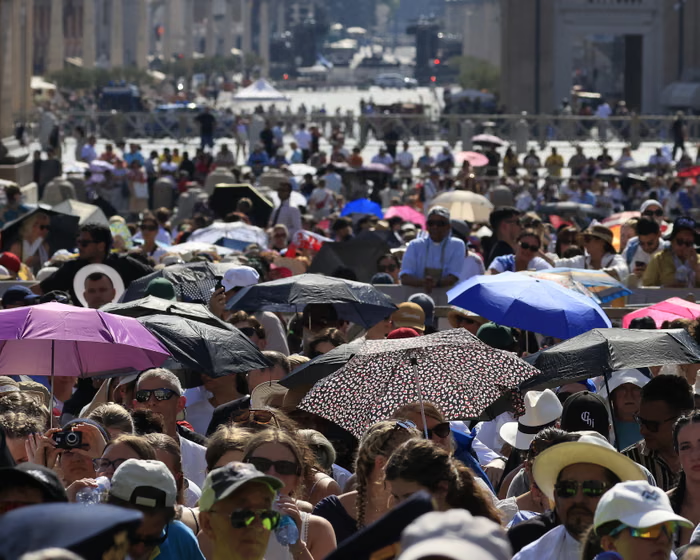
Transport infrastructure across Europe has come under strain as temperatures rise. In Britain, Network Rail warned that high heat can cause rails to expand, increasing the risk of buckling. As a result, speed restrictions have been imposed on some routes, leading to delays and cancellations.
Air travel has also been affected. Intense thunderstorms linked to the heatwave disrupted flights at major airports, including London’s Heathrow, while extreme heat in southern Europe raised concerns about runway safety and aircraft performance.
In France, some regional rail services were cancelled or slowed as operators monitored track temperatures and equipment performance.
Comparisons to the Deadly 2003 Heatwave
The current heatwave has drawn comparisons to the devastating August 2003 heatwave, which claimed an estimated 15,000 lives in France alone. That event exposed serious gaps in preparedness, particularly for elderly people living alone or in poorly ventilated housing.
In the aftermath, France introduced a national heat-alert system and improved coordination between health services, local authorities, and emergency responders. While these measures have reduced mortality in subsequent heatwaves, experts warn that rising temperatures are once again testing the limits of existing systems.
Climate Change Intensifying Heat Extremes
Scientists are clear that climate change is playing a central role in the severity of the current heatwave. Europe is warming faster than any other continent, with temperatures rising at more than twice the global average.
According to the World Meteorological Organization, prolonged heat episodes are becoming more frequent and more intense due to the accumulation of greenhouse gases in the atmosphere. These conditions increase the risk of heat exhaustion, heat stroke, wildfires, and drought.
Data from the Copernicus Climate Change Service shows that 2024 was the hottest year on record globally, while Europe experienced its second-highest number of “heat stress” days. The trend has continued into 2025 and 2026, with early-season heatwaves becoming increasingly common.
Rising Human Cost of Extreme Heat
The health impacts of extreme heat are becoming more visible each year. The World Health Organization reported recently that more than 200,000 people across Europe have died from heat-related causes over the past four years. Health experts say many of these deaths were preventable through better urban planning, early warnings, and public awareness.
Extreme heat places particular strain on the cardiovascular and respiratory systems, increasing the risk of heart attacks, strokes, and dehydration. Older adults, infants, outdoor workers, and people with chronic illnesses are especially vulnerable.
Governments Urged to Adapt Faster
As the heatwave continues, climate experts are urging European governments to accelerate adaptation measures. These include expanding green spaces in cities, improving building insulation and ventilation, strengthening early warning systems, and ensuring vulnerable populations have access to cooling and medical support.
Public health campaigns are also focusing on simple but life-saving advice: drink water regularly, avoid strenuous activity during peak heat hours, check on elderly neighbours, and never leave children or pets in parked vehicles.
Outlook Remains Uncertain
Weather services say the current heatwave is exceptionally intense and unusually early, with its full duration still uncertain. While some cooling may arrive later in the week in parts of northern Europe, southern and western regions are expected to remain dangerously hot.
As climate change continues to reshape weather patterns, experts warn that extreme heat may soon become a regular feature of European summers rather than a rare exception.
For now, authorities across France and the wider continent continue to urge caution, vigilance, and solidarity as communities navigate one of the most severe heat events in recent memory.