

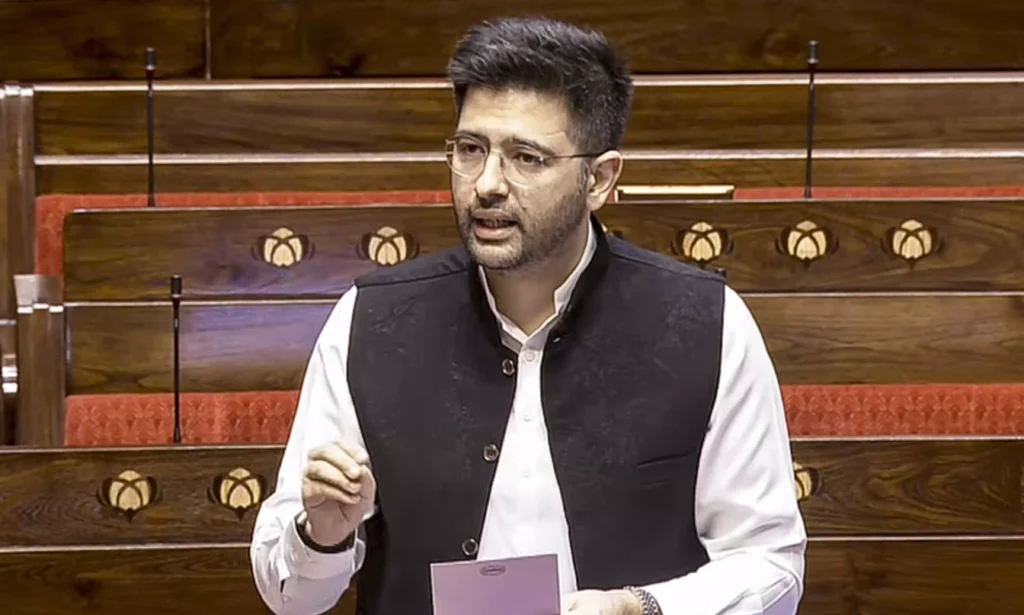
AAP Removes Raghav Chadha as Rajya Sabha Deputy Leader, Asks House Not to Allot Him Speaking Time
In a major political development, the Aam Aadmi Party has removed senior leader Raghav Chadha from the post of Deputy Leader in the Rajya Sabha and formally requested that he no longer be allotted speaking time in the Upper House.
The decision was communicated to the Rajya Sabha Secretariat through official channels and has triggered intense political discussion, with observers closely watching the implications for the party’s parliamentary strategy.
What Happened
According to sources, the party informed the Chairman of the Rajya Sabha that Raghav Chadha would no longer represent the party in his earlier parliamentary capacity. While no detailed explanation was provided publicly, the communication clearly outlined the change in leadership status.
The development comes at a time when Parliament is witnessing heightened political activity, making the decision all the more significant.
Why the Decision Matters
Deputy leaders in Parliament play a key role in managing debates, coordinating with other parties, and articulating the party’s official position. Removing a leader from such a role signals a major shift in internal trust or strategy.
Political analysts say the decision could reflect internal restructuring as the Aam Aadmi Party recalibrates its national ambitions.
Raghav Chadha’s Political Journey
Raghav Chadha rose to prominence as a young and articulate face of the party, often representing it in high-profile debates and discussions. His removal from the deputy leader position marks a significant moment in his political career.
What Lies Ahead
The party is expected to appoint a new deputy leader in the Rajya Sabha in the coming days. Whether Raghav Chadha continues to play a central role within the party will be closely watched.
For now, the development highlights the evolving dynamics of Indian politics, where internal party decisions can have wide-ranging public and parliamentary impact.
Inside the Aam Aadmi Party: Understanding the Internal Context
The decision to remove Raghav Chadha from the position of deputy leader in the Rajya Sabha has drawn attention to the internal functioning of the Aam Aadmi Party. Since its formation, the party has projected itself as an alternative to traditional political structures, emphasizing collective leadership and accountability.
As the party expanded beyond Delhi and entered the national political arena, its organizational requirements evolved. Managing parliamentary strategy at the national level requires discipline, coordination, and alignment with leadership decisions.
According to sources familiar with internal deliberations, recent months witnessed intensive discussions on how the party should conduct itself in Parliament, especially on sensitive national and economic issues.
Raghav Chadha’s Role in Parliament
Raghav Chadha emerged as one of the most visible parliamentary faces of the party. With a legal background and sharp debating skills, he frequently represented the party’s position on governance, fiscal policy, and institutional accountability.
As deputy leader in the Rajya Sabha, his responsibilities went beyond speeches. He played a role in coordinating with other opposition parties, negotiating debate time, and articulating the party’s legislative priorities.
Political observers note that high-profile visibility can sometimes create internal challenges, particularly when leadership seeks greater message discipline.
Timeline of Developments
Key Events Leading to the Decision
Early 2025: Internal review of parliamentary coordination begins.
Mid 2025: Leadership discusses consistency in floor strategy.
Late 2025: Evaluation of leadership roles in the Rajya Sabha.
April 2026: Formal communication removing Chadha as deputy leader.
While the party has not publicly connected these developments, the sequence suggests a gradual process rather than a sudden or impulsive decision.
Political and Public Reactions
Opposition parties reacted strongly, describing the move as politically significant. Several leaders questioned whether the decision pointed to internal disagreements or represented a strategic recalibration by the party.
Public response on social media was divided. While supporters highlighted Raghav Chadha’s parliamentary contributions, others defended the party’s authority to reorganize its leadership structure.
Parliamentary Norms and Party Authority
Under parliamentary procedure, parties retain the authority to appoint or remove their leaders within the House. Such changes are communicated officially to the Chairman and implemented accordingly.
Experts note that while individual Members of Parliament retain their right to speak, recognition as a party representative depends entirely on party authorization.
Impact on the Party’s National Strategy
As the Aam Aadmi Party positions itself as a national political force, discipline and coherence in parliamentary messaging have become critical. This decision may indicate a shift toward tighter internal coordination.
Whether this strengthens the party’s national appeal or creates internal friction will depend on how leadership manages communication and inclusivity going forward.
Is This Unprecedented in Indian Politics?
The removal of a sitting Member of Parliament from a senior parliamentary role may appear extraordinary, but political observers note that such decisions have occurred across party lines in India’s parliamentary history.
What makes the present development stand out is the public prominence of the leader and the relatively young age of the party taking the decision. For a party that has consistently highlighted internal democracy, the move has naturally drawn intense attention.
How Other Political Parties Have Handled Similar Situations
Congress Party
The Congress has periodically reshuffled its parliamentary leadership to address internal differences or strategic needs. Such changes were often explained as organizational restructuring.
Bharatiya Janata Party
The BJP follows a centralized decision-making structure, where parliamentary roles are closely aligned with leadership directives. Changes are implemented swiftly and with minimal public debate.
Regional Parties
Several regional parties have also removed prominent leaders from legislative responsibilities to reinforce party discipline during crucial political phases.
Viewed in this broader context, the Aam Aadmi Party’s move fits within established political practice, even if its execution remains sensitive.
The Question of Party Discipline
Parliamentary leadership positions are not merely symbolic; they reflect organizational trust and strategic alignment. Removing a leader from such a role signals a recalibration of internal expectations.
Analysts argue that the decision may be rooted more in messaging discipline than individual performance. In modern parliamentary politics, consistency in communication is increasingly critical.
Media Coverage and Public Narrative
The media response has been wide-ranging, with debates focusing on whether the development indicates internal instability or strategic consolidation. Editorials and panel discussions have reflected sharply divided opinions.
Supporters of the party emphasize its right to make internal decisions, while critics question whether the move aligns with its founding principles. How the leadership frames the narrative will significantly shape public perception.
Impact on Emerging Political Leadership
Raghav Chadha’s political rise had symbolized the entry of younger professionals into national politics. His removal from a prominent parliamentary role has therefore triggered wider conversations on leadership, loyalty, and independence within party structures.
Some observers see this as a necessary reality of organizational politics, while others worry it could discourage independent thinking among emerging leaders.
A Strategic Turning Point
There is growing speculation that the party may be moving toward a more centralized leadership model as it expands nationally. Such transitions are common among parties seeking long-term electoral stability.
Whether this proves to be a strengthening moment or a source of future challenges will depend on how inclusively decisions are made and communicated.
Conclusion
The decision to remove Raghav Chadha as deputy leader in the Rajya Sabha represents a defining internal moment for the Aam Aadmi Party. It highlights the delicate balance between discipline, democracy, and leadership in contemporary Indian politics.
As events unfold, this episode will likely be studied as an example of how emerging parties navigate internal power structures while operating under intense public scrutiny.
What Lies Ahead for Raghav Chadha
The removal of Raghav Chadha from the position of deputy leader in the Rajya Sabha does not automatically diminish his standing as a Member of Parliament. He continues to retain his seat in the Upper House and remains a recognised political figure with a national profile.
Political observers note that such moments often serve as turning points. Some leaders use them to recalibrate their roles within party structures, while others adopt a lower public profile before re-emerging in different capacities.
Much will depend on how Chadha positions himself in the coming months and how the party leadership chooses to engage with him going forward.
Implications for the Aam Aadmi Party
For the Aam Aadmi Party, the episode carries both risks and opportunities. On one hand, it reinforces the message that parliamentary roles are tied to internal discipline and alignment with leadership strategy. On the other, it exposes the party to criticism from those who view such decisions as contradicting its founding emphasis on internal democracy.
As the party expands its footprint nationally, maintaining coherence in parliamentary messaging is likely to remain a priority. How the leadership balances discipline with inclusivity will shape its long-term organisational health.
Parliamentary Impact in the Short Term
In the immediate term, the party will need to appoint or designate a new deputy leader in the Rajya Sabha to manage legislative coordination. This appointment will be closely watched for signals about the party’s future parliamentary approach.
Observers also point out that the manner in which debates, questions, and interventions are handled in the coming sessions will offer clues about whether the party’s internal reset has achieved its intended objectives.
Broader Lessons from the Episode
Beyond individual personalities, the development highlights a recurring theme in Indian politics: the tension between individual prominence and collective decision-making. As parties grow, such tensions often intensify.
The episode also underscores the reality that internal party decisions, once confined to closed-door discussions, now play out under intense public and media scrutiny.
Final Word
The decision to remove Raghav Chadha as deputy leader in the Rajya Sabha marks a significant internal moment for the Aam Aadmi Party. It reflects the challenges faced by emerging political forces as they transition from movement-based politics to institutional parliamentary functioning.
Whether this move strengthens organisational discipline or creates new internal challenges will only become clear over time. For now, it stands as a reminder that in politics, internal decisions often carry consequences as profound as public electoral outcomes.