

Political Emergence — The Rise of a New Voice
In Indian politics, few trajectories have been as rapid and scrutinised as that of Raghav Chadha. A chartered accountant by training and a politician by choice, Chadha came into the limelight as part of the Aam Aadmi Party (AAP), a political formation that emerged from grassroots activism and anti-corruption movements, promising a break from conventional politics.
Born on November 11, 1988, in Delhi, Chadha entered public life with professional heft rarely seen among young Indian politicians. His early education at Modern School, New Delhi, followed by study at the University of Delhi and Chartered Accountancy credentials from the Institute of Chartered Accountants of India gave him a technical grounding that became central to his political persona. Later, he also attended the London School of Economics.
Chadha’s rise within AAP was emblematic of the party’s broader narrative — urban orientation, data-driven arguments, and a claim to governance expertise rather than mere rhetoric. As one of the party’s youngest leaders, he was entrusted with defence of complex policy positions in televised debates and party communications, which strengthened his profile among urban and middle-class voters.
By 2022, Chadha had transitioned from state-level politics to national prominence when he was elected to the Rajya Sabha — the upper house of India’s Parliament — representing Punjab. At the time, this made him one of the youngest members in the Upper House.
Over the years that followed, he became known for focused parliamentary interventions on issues ranging from telecom sector pricing norms to the rights of gig workers, and even proposals for democratic reform such as a “Right to Recall” mechanism for elected legislators — a proposal that sparked discussion in Parliament but also political resistance.
Throughout his early national career, Chadha’s image blended professional acumen with media visibility, setting him apart in a political environment where popular appeal is often driven more by mass appeal than technical debate. His ability to translate complex economic questions into understandable narratives gave him a distinct presence among both political commentators and civil society observers.
However, the very attributes that once seemed to secure his political elevation also later became points of contention — particularly when internal party expectations demanded strict alignment with broader strategies and messaging around core issues.
By early 2025, as AAP navigated electoral challenges and high-stakes political confrontations with national parties, Chadha’s role began to attract closer scrutiny, both inside and outside his party. While supporters continued to view him as an articulate voice for contemporary issues affecting the urban electorate, critics within the party began to hint at tensions between individual visibility and collective party discipline.
These early foundations — a blend of professional credibility and public mobilization — laid the groundwork for a political identity that has since moved from ascendant optimism to complex negotiation with party priorities, parliamentary strategy, and leadership dynamics.
Peak Influence, Parliament, and Party Trust
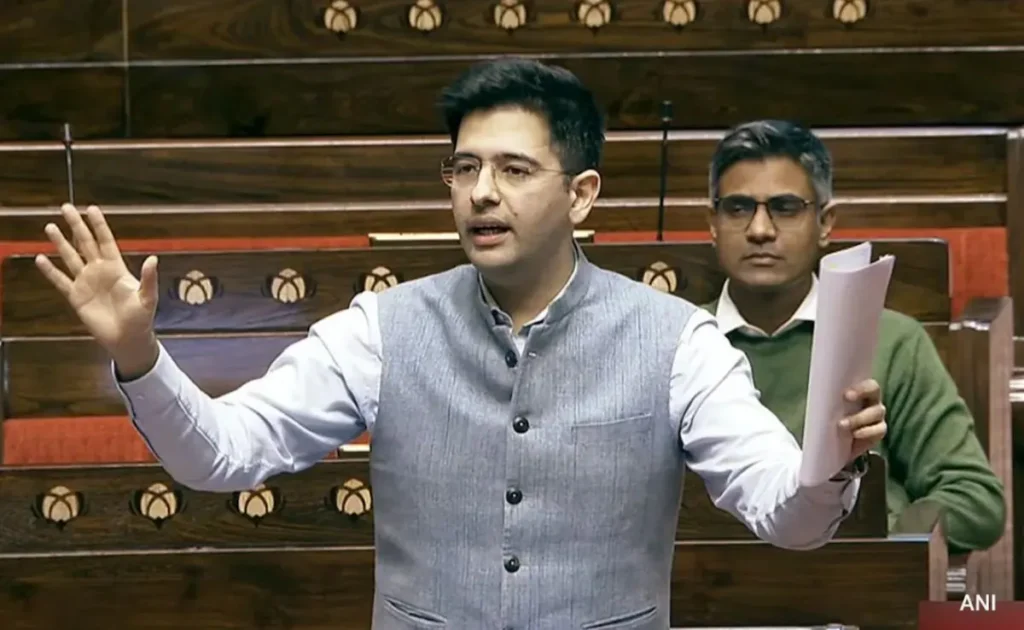
By the early 2020s, Raghav Chadha had firmly established himself as one of the most visible young leaders within the Aam Aadmi Party. His transition from party spokesperson to a national legislator marked the high point of his political ascent. The decision to send him to the Rajya Sabha was widely interpreted as a clear signal of trust from the party’s top leadership.
Representing Punjab in the Upper House, Chadha entered Parliament at a time when the party was attempting to expand its footprint beyond Delhi. His nomination was strategic—he was young, articulate, and capable of presenting the party’s positions in a manner that resonated with both lawmakers and the media.
Inside Parliament, Chadha focused on issues that aligned with his professional background. He frequently raised questions related to public finance, economic reforms, and institutional accountability. His interventions were often detailed, data-driven, and prepared with technical precision, reinforcing his reputation as a policy-oriented legislator rather than a rhetorical performer.
During this period, Chadha also became a regular participant in parliamentary committees and policy discussions. His presence in these forums strengthened the perception that he was being groomed for a larger leadership role within the party’s national structure.
Key Highlights of This Phase
- Entry into the Rajya Sabha as one of the youngest MPs
- Focus on economic, governance, and institutional reform issues
- High visibility in parliamentary debates and media interactions
- Strong alignment with the party’s national expansion strategy
Beyond Parliament, Chadha remained a prominent media face for the party. Whether defending government policies, countering opposition attacks, or explaining legislative proposals, he continued to be deployed as a key communicator. His calm demeanor and structured arguments stood out in an increasingly polarized political environment.
Within the party organisation, his influence appeared to peak during this phase. He was seen as part of an emerging second line of leadership—figures who could potentially take on larger responsibilities as the party matured. Supporters viewed him as a bridge between activism-driven politics and governance-focused administration.
However, this period of prominence also came with rising expectations. As the party expanded into new states and faced more complex political challenges, internal dynamics began to shift. Decision-making became more centralized, and the margin for individual political expression narrowed.
While Chadha continued to perform his parliamentary role diligently, subtle changes became noticeable. His appearances in major party announcements reduced, and his role in shaping public narratives appeared less central than before. These changes did not attract immediate attention, but they marked the beginning of a quieter phase in his political journey.
For observers, this stage represented a paradox. On paper, Chadha’s political credentials had never been stronger—an MP, a recognized policy voice, and a trusted party representative. Yet, behind the scenes, the party’s internal priorities were evolving, setting the stage for a reassessment of roles and influence.
This phase of peak visibility and institutional authority would soon give way to questions about positioning, relevance, and the costs of navigating a tightly controlled political organization.
Punjab, Power Shifts, and the Quiet Fade
The next phase of Raghav Chadha’s political journey unfolded against the backdrop of the Aam Aadmi Party’s dramatic rise to power in Punjab. The state’s overwhelming mandate was widely seen as a turning point for the party, marking its first major expansion beyond Delhi. For leaders like Chadha, Punjab represented both opportunity and risk.
Initially, Chadha played a visible role in articulating the party’s vision for Punjab. As a Rajya Sabha member from the state, he was expected to act as a bridge between the state government and the national leadership. His understanding of governance and communication made him a natural choice for this role.
However, as the new government settled in, the political dynamics within the party began to change. Decision-making became increasingly centralized, and the leadership structure tightened. The emphasis shifted from public messaging to internal discipline and control, especially as the party faced scrutiny from opposition parties and central agencies.
During this period, Chadha’s public visibility began to decline. His presence in major press conferences reduced, and he was no longer among the most frequently deployed spokespersons during political flashpoints. While he continued his parliamentary work, his absence from high-profile party narratives became noticeable.
What Changed?
As the party transitioned from challenger to governing force in multiple states, individual prominence gave way to collective messaging. Leaders who once thrived on media visibility found their roles recalibrated within a more tightly managed political framework.
Political observers began to speculate on the reasons behind this shift. Some suggested that Chadha’s technocratic style was better suited to policy discussions than mass political mobilisation. Others pointed to internal realignments, where newer power centres within the party gained prominence, altering the balance of influence.
Importantly, there was no public fallout or open disagreement. Unlike high-profile exits or rebellions seen in other parties, Chadha’s reduced visibility was marked by silence rather than confrontation. This made the change more intriguing, as it unfolded without dramatic statements or public disputes.
Supporters argued that Chadha was focusing on behind-the-scenes work and parliamentary responsibilities, avoiding the noise of daily political battles. Critics, however, interpreted the silence as a sign that he had been sidelined in favour of leaders with stronger organisational or mass-connect credentials.
The Punjab chapter thus became a subtle turning point. While it elevated the party nationally, it also reshaped internal hierarchies. Leaders who were once central to the party’s public image found themselves navigating a new reality, where loyalty and alignment mattered more than individual brand value.
By the end of this phase, Chadha remained an elected MP with intact formal authority, but his informal influence appeared diminished. The contrast between his earlier prominence and current quietude was stark, prompting questions about the sustainability of merit-driven politics within highly centralised party structures.
This period set the stage for the most critical question of his career so far: whether silence was merely a pause—or the beginning of a longer political marginalisation.
In a video message, Chadha said that whenever he gets an opportunity to speak in Parliament, he raises issues concerning the common people — topics that are often overlooked. He questioned why he was being stopped and asked whether raising public concerns was a crime.
Silenced, not defeated
— Raghav Chadha (@raghav_chadha) April 3, 2026
My message to the ‘aam aadmi’
—
खामोश करवाया गया हूँ, हारा नहीं हूँ
'आम आदमी’ को मेरे संदेश pic.twitter.com/poUwxsu0S3
Media Silence, Speculation, and Strategic Restraint
As Raghav Chadha’s public appearances declined, political and media circles began to take notice. In contemporary politics, silence itself often becomes a statement, particularly when it follows a period of sustained visibility. Chadha’s reduced presence on television debates, press briefings, and social media platforms triggered a wave of speculation about his standing within the party.
For journalists tracking internal party dynamics, the absence raised questions rather than answers. There was no official announcement redefining his role, no public reprimand, and no visible conflict. Instead, there was a noticeable shift in narrative management, with other leaders emerging as the party’s primary voices during politically sensitive moments.
This phase highlighted a broader transformation within the party’s communication strategy. Messaging became more tightly controlled, with fewer spokespersons authorised to speak on contentious issues. In such an environment, leaders known for independent articulation and policy-heavy arguments found themselves operating within narrower boundaries.
Silence as Strategy?
Political silence can serve multiple purposes — it may reflect internal caution, strategic withdrawal, or a conscious decision to avoid controversy during volatile periods. In Chadha’s case, the lack of counter-narrative left room for multiple interpretations.
Supporters maintained that Chadha was choosing restraint over reaction. They argued that his focus had shifted towards parliamentary responsibilities and long-term political positioning rather than daily media skirmishes. In an environment increasingly driven by polarisation, silence, they suggested, could be an asset rather than a liability.
Critics, however, saw the situation differently. They viewed the quiet phase as evidence of diminishing influence, pointing out that visibility often correlates with power in modern political organisations. According to this perspective, absence from the public eye signalled exclusion from key decision-making processes.
The ambiguity surrounding Chadha’s position was further amplified by comparisons with other young leaders within the party. Some rose rapidly by demonstrating strong organisational control or mass mobilisation skills, reinforcing the perception that political capital was increasingly tied to ground-level command rather than policy articulation.
This period also revealed the challenges faced by technocratic politicians in highly centralised party structures. While expertise and communication skills can accelerate early growth, sustained influence often depends on alignment with evolving power centres and organisational priorities.
By early 2025, Chadha’s political journey appeared to be at a crossroads. He remained a sitting Member of Parliament, with formal authority and constitutional responsibilities intact. Yet, the informal influence that once defined his rise was no longer as visible.
Whether this phase represented a temporary recalibration or a longer-term sidelining remained unclear. What was evident, however, was that Chadha’s trajectory now symbolised a broader question within Indian politics — how space is negotiated between individual competence and collective control.
Media Silence, Speculation, and Strategic Restraint
As Raghav Chadha’s public appearances declined, political and media circles began to take notice. In contemporary politics, silence itself often becomes a statement, particularly when it follows a period of sustained visibility. Chadha’s reduced presence on television debates, press briefings, and social media platforms triggered a wave of speculation about his standing within the party.
For journalists tracking internal party dynamics, the absence raised questions rather than answers. There was no official announcement redefining his role, no public reprimand, and no visible conflict. Instead, there was a noticeable shift in narrative management, with other leaders emerging as the party’s primary voices during politically sensitive moments.
This phase highlighted a broader transformation within the party’s communication strategy. Messaging became more tightly controlled, with fewer spokespersons authorised to speak on contentious issues. In such an environment, leaders known for independent articulation and policy-heavy arguments found themselves operating within narrower boundaries.
Silence as Strategy?
Political silence can serve multiple purposes — it may reflect internal caution, strategic withdrawal, or a conscious decision to avoid controversy during volatile periods. In Chadha’s case, the lack of counter-narrative left room for multiple interpretations.
Supporters maintained that Chadha was choosing restraint over reaction. They argued that his focus had shifted towards parliamentary responsibilities and long-term political positioning rather than daily media skirmishes. In an environment increasingly driven by polarisation, silence, they suggested, could be an asset rather than a liability.
Critics, however, saw the situation differently. They viewed the quiet phase as evidence of diminishing influence, pointing out that visibility often correlates with power in modern political organisations. According to this perspective, absence from the public eye signalled exclusion from key decision-making processes.
The ambiguity surrounding Chadha’s position was further amplified by comparisons with other young leaders within the party. Some rose rapidly by demonstrating strong organisational control or mass mobilisation skills, reinforcing the perception that political capital was increasingly tied to ground-level command rather than policy articulation.
This period also revealed the challenges faced by technocratic politicians in highly centralised party structures. While expertise and communication skills can accelerate early growth, sustained influence often depends on alignment with evolving power centres and organisational priorities.
By early 2025, Chadha’s political journey appeared to be at a crossroads. He remained a sitting Member of Parliament, with formal authority and constitutional responsibilities intact. Yet, the informal influence that once defined his rise was no longer as visible.
Whether this phase represented a temporary recalibration or a longer-term sidelining remained unclear. What was evident, however, was that Chadha’s trajectory now symbolised a broader question within Indian politics — how space is negotiated between individual competence and collective control.