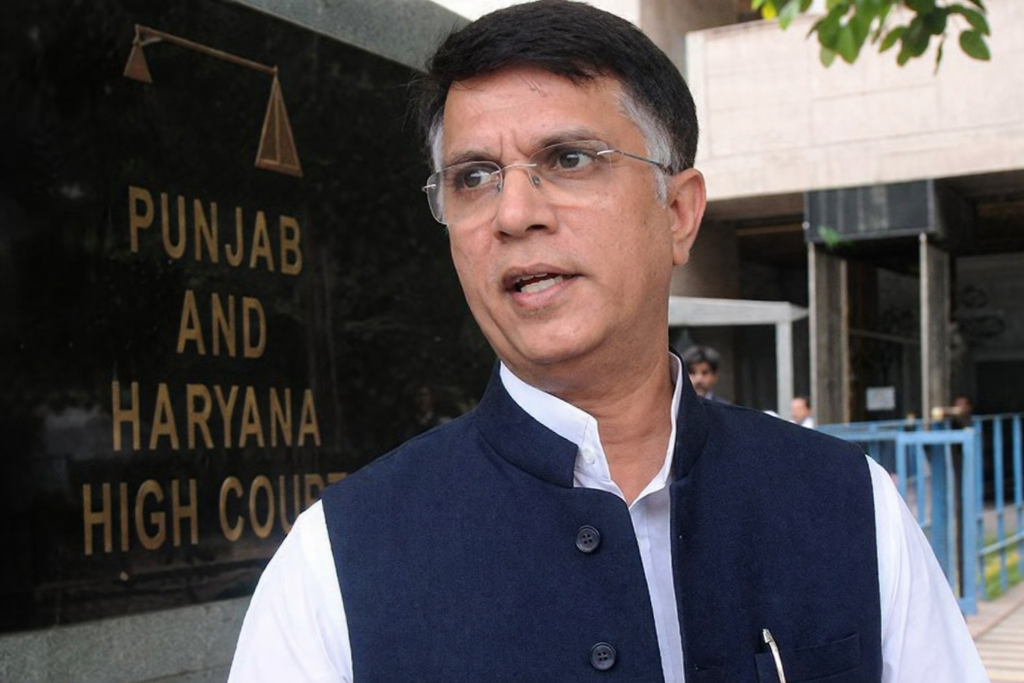
In a significant development with far-reaching political and legal implications, the Supreme Court on Tuesday granted anticipatory bail to Congress leader Pawan Khera in connection with an FIR registered by the Assam Police. The case originated from a complaint filed by Riniki Bhuyan Sarma, the wife of Assam Chief Minister Himanta Biswa Sarma, concerning allegations made by Khera that she possessed multiple foreign passports.
The judgment was delivered by a bench comprising Justice J.K. Maheshwari and Justice A.S. Chandurkar, a day after the court had reserved its verdict on Khera’s plea challenging the Gauhati High Court’s refusal to grant him anticipatory bail. The apex court’s ruling marks a crucial moment in a case that has been widely debated for its legal complexity as well as its political overtones.
While allowing the appeal, the Supreme Court made strong observations regarding the approach adopted by the Gauhati High Court. It noted that certain conclusions drawn by the High Court were not based on a proper evaluation of the material placed before it and appeared to have wrongly shifted the burden of proof onto the accused.
The court further remarked that the allegations and counter-allegations exchanged between the parties, at a prima facie stage, seemed to stem from political rivalry. According to the bench, the factual correctness of such allegations could be appropriately examined during the course of a trial rather than through custodial interrogation at the preliminary stage.
Errors Found in High Court’s Reasoning
In a detailed analysis, the Supreme Court expressed concern over the Gauhati High Court’s observations relating to offences under Section 339 of the Bharatiya Nyaya Sanhita. The apex court pointed out that the FIR did not even contain allegations under that particular provision, making the High Court’s remarks legally unsustainable.
The bench emphasized that courts must rely strictly on the contents of the FIR and the material placed on record, rather than on submissions made orally during arguments. Observations not grounded in the record, the Supreme Court cautioned, could have serious implications for an individual’s liberty.
It further held that the High Court could not have introduced new dimensions to the case solely on the basis of the Advocate General’s statements, without those allegations being reflected in the FIR itself.
Relief Granted with Conditions
Granting anticipatory bail, the Supreme Court directed that Pawan Khera shall be released in the event of his arrest in the case. At the same time, the court imposed standard conditions to ensure the integrity of the investigation.
Khera has been directed to fully cooperate with the investigating agency and to appear before the investigating officer whenever required. He has also been restrained from leaving the country without prior permission of the court and has been instructed not to tamper with evidence or influence witnesses in any manner.
The bench clarified that the investigation must continue independently and with fairness, stressing that the grant of anticipatory bail does not amount to an endorsement of the allegations or a comment on their truthfulness.
Observations on Political Climate
The judgment also recorded that public statements and remarks made in the course of political exchanges had contributed to the atmosphere surrounding the case. The court noted that certain remarks attributed to the Chief Minister against Khera were “unparliamentary” in nature and had included threats of arrest.
Taking an overall view of the circumstances, the Supreme Court held that judicial intervention was necessary to ensure that the fundamental right to personal liberty was not compromised due to political hostility or competitive rivalry.
“At this stage, we are conscious of the fact that personal liberty enshrined under Article 21 of the Constitution cannot be placed in jeopardy lightly,” the court stated, adding that this constitutional protection must be balanced with the state’s duty to conduct a fair investigation.
Background of the Case
The case traces its origin to an FIR lodged at the Guwahati Crime Branch Police Station based on a complaint by Riniki Bhuyan Sarma. The complaint accused Pawan Khera of making false public claims regarding her alleged possession of multiple foreign passports and purported financial interests outside India.
Based on the complaint, the Assam Police invoked several provisions of the Bharatiya Nyaya Sanhita, including sections relating to false statements, cheating, forgery, use of forged documents, intentional insult, and defamation.
Khera initially approached the Telangana High Court, which granted him interim transit anticipatory bail for a limited period to enable him to seek relief from the appropriate court in Assam. However, the Supreme Court subsequently stayed the operation of that order, clarifying that any application filed before the Assam courts should be considered independently.
Following this, Khera moved the Gauhati High Court seeking anticipatory bail. The High Court declined relief, observing that the case went beyond simple defamation and that custodial interrogation was necessary to determine the source of the documents relied upon by the Congress leader.
Challenging this decision, Khera approached the Supreme Court, arguing that the High Court had failed to appreciate the political context of the dispute and had overlooked the constitutional safeguards relating to personal liberty.
Supreme Court’s Final Word
In its concluding remarks, the Supreme Court reiterated that while the state has a legitimate interest in conducting a thorough and impartial investigation, such an interest cannot override the fundamental rights guaranteed under the Constitution.
The bench emphasized that courts must carefully balance the competing considerations of state authority and individual freedom, particularly in cases where allegations appear intertwined with political rivalry.
With the grant of anticipatory bail, the Supreme Court has provided temporary relief to Pawan Khera while leaving all substantive issues open to be examined during the course of the investigation and trial.