

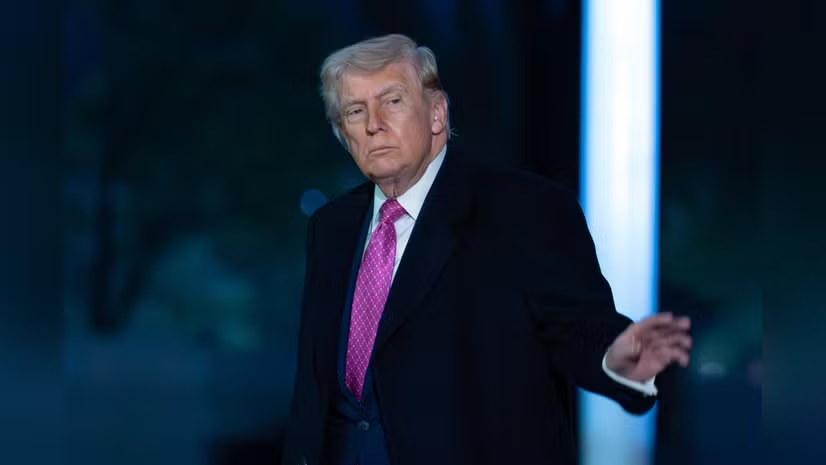
Trump Open to Ending Iran Military Campaign Even if Hormuz Remains Shut
The United States may be preparing for a major strategic shift in its ongoing military campaign against Iran, as President Donald Trump is reportedly open to ending active combat operations even if the strategically vital Strait of Hormuz remains closed, according to senior administration discussions cited by multiple international reports.
The development marks a potentially significant recalibration of Washington’s objectives in the escalating Middle East conflict that has drawn in Iran, Israel, and several regional powers, while sending shockwaves through global energy markets and diplomatic circles.
Sources familiar with internal deliberations say the White House no longer considers the immediate reopening of the Strait of Hormuz as a core military objective, despite its role as one of the world’s most critical maritime chokepoints for oil and gas shipments. Instead, the focus appears to be shifting toward limiting the duration of the conflict, containing regional escalation, and preserving U.S. military and economic leverage.
- Trump reportedly open to ending Iran military campaign
- Reopening Strait of Hormuz no longer a primary war goal
- Oil markets, shipping, and global trade face uncertainty
- Allies express concern over long-term energy security
This reported stance represents a notable departure from earlier rhetoric that emphasized keeping Hormuz open “at all costs,” and it comes amid growing concerns over prolonged war fatigue, rising oil prices, and the humanitarian impact of sustained hostilities across the region.
Why This Statement Matters
The Strait of Hormuz, a narrow stretch of water connecting the Persian Gulf to the Arabian Sea, handles nearly one-fifth of the world’s daily oil supply. Any prolonged disruption has immediate consequences for global energy security, inflation, and geopolitical stability.
Since early March 2026, Iran has effectively restricted shipping through the strait following a series of U.S. and Israeli airstrikes on Iranian military, naval, and industrial infrastructure. Tehran has framed the move as a defensive response, while Washington has described it as an act of economic warfare.
Against this backdrop, President Trump’s reported willingness to conclude military operations without first restoring full commercial navigation through Hormuz has stunned analysts and allies alike.
Inside the White House: A Shift in War Goals
According to officials briefed on the discussions, the U.S. administration has begun reassessing the cost-benefit balance of a prolonged military campaign aimed at forcing Iran to reopen the strait.
Military planners have reportedly warned that any effort to forcibly reopen Hormuz would involve extensive naval operations and significant risk escalation.
- Clearing Hormuz would require sustained naval dominance
- Iran retains asymmetric capabilities including sea mines and drones
- Escalation could draw Gulf states into direct confrontation
As a result, the White House is said to be prioritizing strategic degradation of Iranian military capabilities over total control of maritime routes, leaving the issue of Hormuz to future diplomatic or multinational efforts.
Global Implications Begin to Emerge
The potential U.S. pullback, even a partial one, raises urgent questions for policymakers and markets alike.
- Will Iran maintain control over Hormuz as leverage?
- Can global markets tolerate long-term disruption?
- Are U.S. allies prepared to fill a security vacuum?
- Is this de-escalation or a strategic pause?
Energy analysts note that oil prices have already surged to multi-year highs, while shipping insurers have sharply increased premiums for vessels operating in the Gulf.
Expert View: Strategic Calculation, Not Retreat
Defense and foreign policy experts caution that ending active combat does not necessarily mean abandoning strategic pressure.
Instead, analysts argue the administration may be attempting to avoid a drawn-out war, shift responsibility to regional coalitions, preserve political capital amid domestic pressures, and force Iran into indirect negotiations.
“The administration appears to be calculating that indefinite war is more dangerous than a managed stalemate,” said one senior security analyst familiar with U.S. planning.
DIPLOMATIC CALCULUS: WHY WASHINGTON MAY BE STEPPING BACK
Senior diplomats and former defense officials suggest that President :contentReference[oaicite:0]{index=0}’s reported openness to ending the Iran military campaign reflects a growing belief inside Washington that the conflict has reached a point of diminishing returns.
While the original objective focused on curbing Iran’s regional military reach and safeguarding maritime routes, prolonged hostilities have introduced new risks — from economic instability to the erosion of international support.
- U.S. war planners warn of long-term naval overstretch
- Energy disruption outweighing battlefield gains
- Allied pressure mounting for diplomatic solutions
- Domestic political costs rising amid economic strain
SHIFT FROM FORCE TO LEVERAGE
Rather than pursuing absolute control over the :contentReference[oaicite:1]{index=1}, the administration appears to be recalibrating its strategy toward indirect pressure — including sanctions enforcement, intelligence operations, and diplomatic isolation.
Analysts say this allows Washington to maintain strategic influence without committing to an open-ended military confrontation that could engulf the region.
IRAN’S STRATEGIC RESPONSE: RESTRAINT WITH RESOLVE
In Tehran, officials have responded cautiously to reports of a potential U.S. military drawdown. While Iranian state media portrays the shift as a validation of resistance, policymakers remain wary of premature de-escalation.
According to regional observers, :contentReference[oaicite:2]{index=2} is likely to:
- Maintain partial control over Hormuz as leverage
- Avoid provocations that could justify renewed strikes
- Signal openness to mediated negotiations
- Strengthen defensive naval capabilities
A CONTROLLED STALEMATE?
Experts describe the emerging situation as a “managed stalemate” — a scenario where neither side escalates dramatically, but neither fully concedes ground.
Such a balance, while fragile, could buy time for diplomatic initiatives aimed at restoring limited shipping access without triggering a broader war.
GLOBAL ENERGY MARKETS: BRACING FOR UNCERTAINTY
Even without full-scale combat, the continued disruption in Hormuz poses serious risks for global energy markets. Traders, insurers, and governments remain on edge.
- Oil prices remain near multi-year highs
- Shipping insurance premiums doubled in weeks
- Strategic reserves under review worldwide
- Import-dependent nations most vulnerable
Economists warn that prolonged uncertainty — even without active warfare — could ripple through supply chains, inflation rates, and geopolitical alliances.
WHAT THIS MEANS GOING FORWARD
The possibility that the United States may end active military operations without reopening Hormuz marks a profound shift in modern conflict management — where economic realities and political endurance increasingly shape battlefield decisions.
Whether this moment leads to de-escalation or simply postpones further confrontation will depend on diplomatic engagement, regional restraint, and the fragile balance of power in one of the world’s most volatile regions.
POLITICAL FALLOUT IN WASHINGTON
President :contentReference[oaicite:0]{index=0}’s reported openness to ending the Iran military campaign — even with the :contentReference[oaicite:1]{index=1} still restricted — has sparked intense debate within U.S. political circles.
Lawmakers from both parties are divided. Some argue that prolonging military operations risks dragging the United States into an unwinnable regional conflict, while others warn that stepping back could embolden adversaries and weaken deterrence.
DIVIDED CONGRESS, DIVIDED MESSAGE
Senior members of Congress have privately raised concerns about the long-term economic and military costs of sustained operations, particularly as inflation pressures and energy prices affect American households.
At the same time, hawkish voices caution that allowing Hormuz to remain disrupted could undermine global confidence in U.S. security guarantees.
- Rising domestic concern over fuel prices
- Growing skepticism of open-ended wars
- Election-year political calculations
- Allied expectations versus national priorities
A CONFLICT MEASURED IN PHASES, NOT VICTORIES
Military analysts increasingly describe the Iran conflict not as a conventional war, but as a phased confrontation — defined by pressure, signaling, and restraint rather than decisive battlefield victories.
In this framework, the reported U.S. willingness to halt active combat represents a transition to a new phase rather than an endpoint.
THE TIMELINE SO FAR
- Late 2025: Rising cyber and maritime tensions
- Early March 2026: Coordinated air and naval strikes
- Mid-March 2026: Iran restricts shipping through Hormuz
- Late March 2026: Energy markets surge, insurers pull back
- Early April 2026: U.S. signals openness to ending combat
Each phase has reshaped the strategic landscape, forcing policymakers to adapt objectives in response to economic, diplomatic, and military realities.
IS THIS THE BEGINNING OF THE END?
Whether the current moment marks the beginning of de-escalation or merely a pause before renewed confrontation remains uncertain.
What is clear, however, is that the conflict has already altered assumptions about modern warfare — highlighting how economic chokepoints, public endurance, and global markets can constrain even the most powerful militaries.
As the world watches closely, the coming weeks will test whether diplomacy can succeed where force has reached its limits.
LEGAL AND HUMANITARIAN DIMENSIONS COME INTO SHARP FOCUS
As active military operations appear to approach a possible pause, international legal experts and humanitarian agencies are intensifying scrutiny of the conflict’s impact on civilian infrastructure and essential services.
Particular concern has been raised over strikes and disruptions affecting ports, power grids, and water facilities — assets protected under international humanitarian law.
- Disruption to water and electricity supplies
- Rising fuel and food costs for civilians
- Job losses linked to shipping and trade slowdowns
- Environmental risks in sensitive maritime zones
LEGAL SCRUTINY AND INTERNATIONAL NORMS
Legal scholars note that while states retain the right to self-defense, prolonged operations near civilian infrastructure invite closer examination under the laws of armed conflict.
Calls are growing for independent assessments and confidence-building measures to prevent further civilian harm as diplomatic channels reopen.
THE STRATEGIC ENDGAME: PRESSURE WITHOUT PERMANENCE
Analysts argue that President :contentReference[oaicite:0]{index=0}’s reported openness to ending the campaign reflects a broader shift in how modern conflicts are concluded — not through decisive victory, but through managed pressure and negotiated restraint.
In this model, military force establishes leverage, while diplomacy determines outcomes. The future of the :contentReference[oaicite:1]{index=1} may ultimately be shaped more by talks than by warships.
- Back-channel diplomatic engagement
- Multinational maritime security talks
- Limited confidence-building measures
- Continued economic and political pressure
A MOMENT OF DECISION FOR THE REGION
The Iran conflict now stands at a decisive juncture. A misstep could reignite escalation, while careful diplomacy could stabilize one of the world’s most critical energy corridors.
Whether this phase becomes the beginning of de-escalation or merely an intermission will depend on restraint, communication, and the willingness of all parties to accept compromise over confrontation.
For the global community, the lesson is clear: in an interconnected world, wars are no longer confined to battlefields — their consequences ripple through markets, households, and international stability.
CONCLUSION: A WAR DEFINED BY LIMITS, NOT VICTORY
President :contentReference[oaicite:0]{index=0}’s reported openness to ending the Iran military campaign — even as the :contentReference[oaicite:1]{index=1} remains disrupted — underscores a defining reality of modern conflict: military power alone no longer guarantees decisive outcomes.
What began as a campaign to deter aggression and protect global shipping evolved into a broader test of endurance — economic, political, and diplomatic. As costs mounted and risks multiplied, Washington appears to have recalibrated its objectives toward containment rather than conquest.
This moment does not mark a clear victory for any side. Instead, it reflects the limits of force in an interconnected world where energy flows, financial markets, and public tolerance shape the boundaries of war.
For Iran, control over Hormuz has proven to be a powerful lever — one that exerts pressure far beyond the battlefield. For the United States and its allies, the challenge now lies in preventing that leverage from hardening into a permanent disruption of global trade.
KEY TAKEAWAYS AT A GLANCE
- The U.S. may end active combat without reopening Hormuz
- The conflict has shifted from military dominance to strategic restraint
- Energy markets and global trade remain highly vulnerable
- Diplomacy is likely to replace force as the primary tool
- A fragile stalemate now defines the regional balance
WHAT HAPPENS NEXT WILL SHAPE THE REGION
The coming weeks will determine whether this phase becomes a gateway to de-escalation or merely a pause before renewed confrontation. Much will depend on diplomatic engagement, regional cooperation, and the willingness of all parties to avoid miscalculation.
For the world, the stakes extend far beyond the Middle East. The stability of global energy routes, inflation trends, and international security norms now hinge on decisions made not only in capitals, but in negotiating rooms far from the battlefield.
As history has often shown, wars rarely end with a single announcement. They fade, shift, and transform — leaving behind lessons that reshape how future conflicts are fought, restrained, and resolved.