


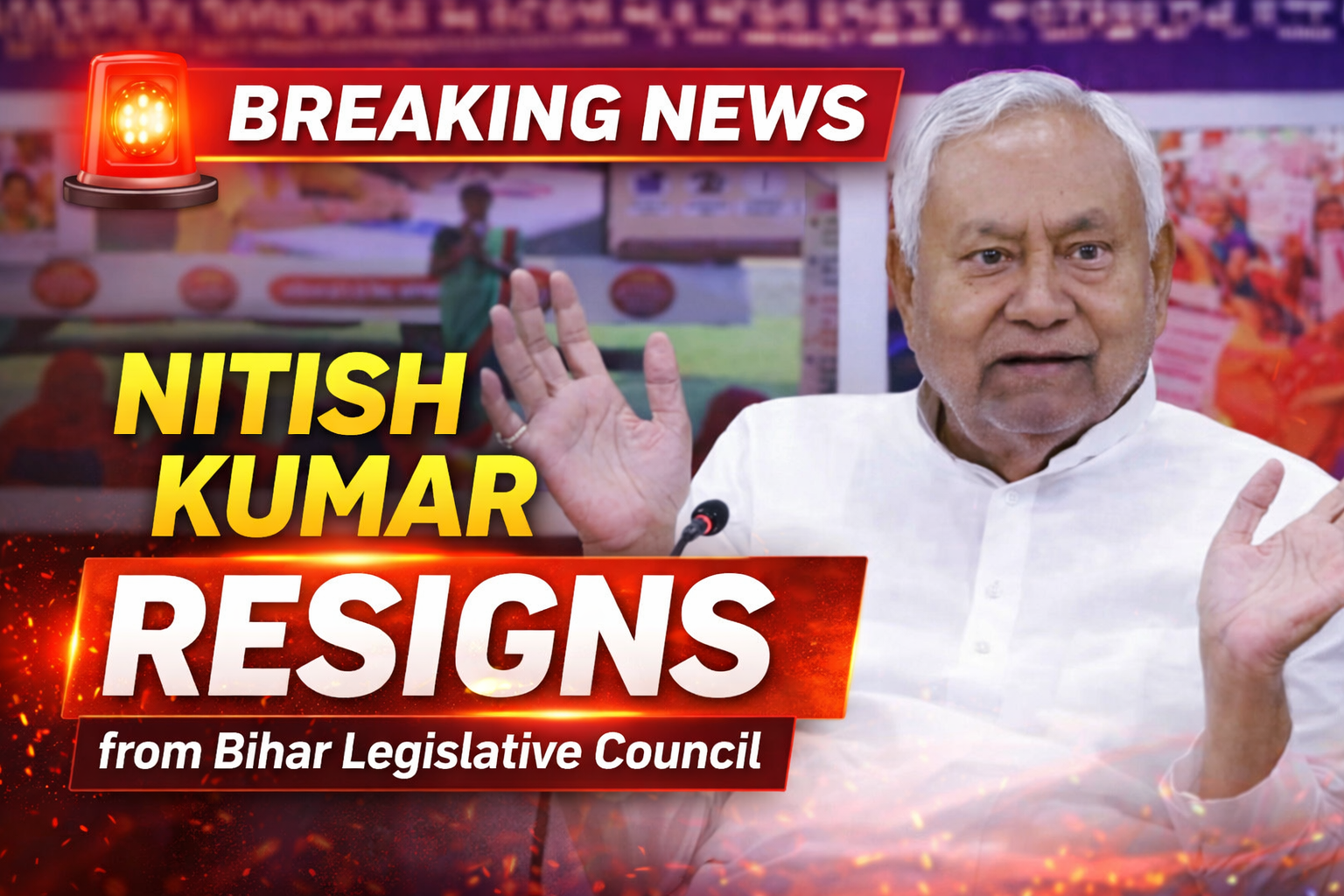
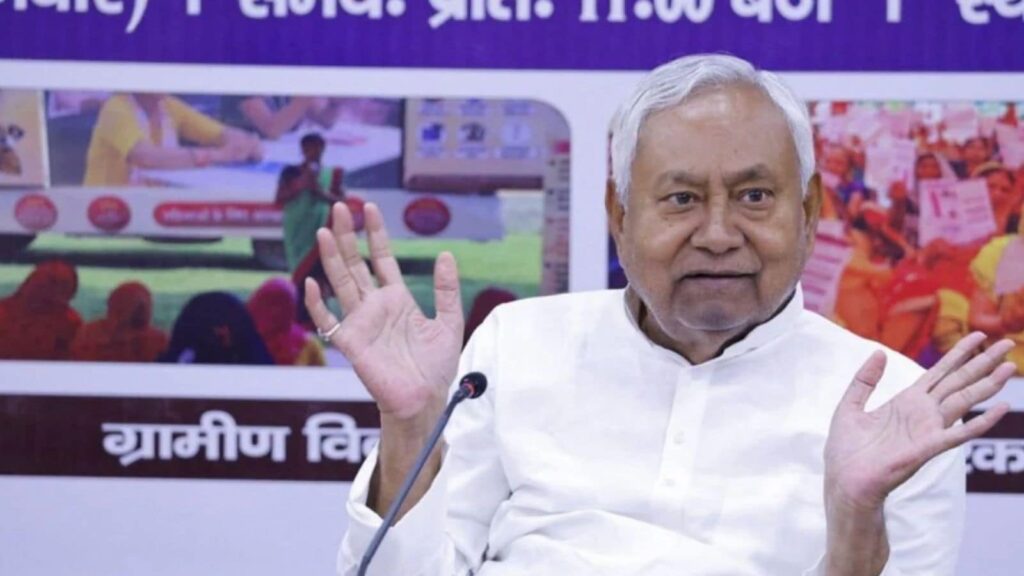
Bihar Chief Minister Nitish Kumar has formally resigned from the Bihar Legislative Council, triggering widespread political discussion across the state and at the national level. While the resignation has sparked speculation and intense debate, constitutional experts and senior political leaders have clarified that the move is procedural in nature and does not immediately affect his position as the Chief Minister of Bihar.
The development follows Nitish Kumar’s recent election to the Rajya Sabha, the Upper House of Parliament, a transition that constitutionally requires him to vacate his seat in the state legislature. The resignation, therefore, is seen as a legal necessity rather than a political surrender or leadership exit.
What Happened: The Core Development
On the day of the announcement, Nitish Kumar submitted his resignation from the Bihar Legislative Council (Vidhan Parishad). The resignation was accepted by the appropriate authority, thereby ending his tenure as a Member of the Legislative Council (MLC).
Sources in the state secretariat confirmed that the decision was taken after consultations with legal advisors and senior leaders of the ruling coalition. The move came within the constitutionally prescribed timeframe following his election to Parliament.
Despite stepping down as a legislator, Nitish Kumar continues to hold the office of Chief Minister. Under Indian constitutional provisions, a Chief Minister is allowed to remain in office for up to six months without being a member of the state legislature, provided they secure membership within that period.
Why the Resignation Was Necessary
The Indian Constitution clearly states that an individual cannot simultaneously be a member of Parliament and a state legislature. Once elected to the Rajya Sabha or Lok Sabha, a sitting MLA or MLC must vacate their seat in the state Assembly or Council.
Nitish Kumar’s election to the Rajya Sabha placed him under this constitutional obligation. Legal experts have pointed out that failing to resign would have resulted in disqualification from one of the positions, making the resignation unavoidable.
Political analysts describe this as a “technical exit” rather than a retreat from state politics.
Immediate Political Reactions
The announcement prompted swift reactions across Bihar’s political landscape.
Leaders from Nitish Kumar’s party described the resignation as a routine constitutional process. They emphasized that governance in Bihar would continue uninterrupted and that the Chief Minister remains firmly in charge of the administration.
Opposition parties, however, sought to attach political meaning to the move. Some leaders suggested that the resignation could indicate future leadership transitions, while others claimed it reflected changing power equations within the ruling alliance.
Despite these claims, no official indication has been given about any change in leadership at the state level.
Does This Affect Bihar’s Government?
From a governance standpoint, the resignation has no immediate impact on the functioning of the Bihar government. Nitish Kumar continues to preside over cabinet meetings, oversee policy decisions, and represent the state in administrative and political forums.
Senior bureaucrats have confirmed that all government work is proceeding as normal. Development projects, budgetary processes, and welfare schemes remain unaffected by the procedural change.
The Chief Minister’s Office issued a brief statement clarifying that the resignation should not be interpreted as a step down from executive authority.
Why This News Matters
While the resignation itself is procedural, its timing and context have elevated its significance. Nitish Kumar’s entry into the Rajya Sabha has placed him at the intersection of state and national politics during a sensitive political phase.
Observers believe the move could enhance his role in national policy discussions while allowing him to maintain influence over Bihar’s governance.
Given his long political career and reputation as a key strategist, every move made by Nitish Kumar tends to attract heightened scrutiny.
Public Response in Bihar
Among the general public, reactions have been mixed. Supporters view the development as a sign of Nitish Kumar’s growing national stature. Critics argue that holding positions at both state and national levels could dilute focus.
In urban centers like Patna, political discussions have intensified, with debates focusing on whether the Chief Minister will eventually seek re-entry into the state legislature or focus more on parliamentary responsibilities.
In rural areas, the response has largely been muted, with many residents more concerned about governance delivery than procedural changes.
Understanding the Legislative Council Exit
The Bihar Legislative Council is the Upper House of the state legislature, and its members are elected through various constituencies, including graduates, teachers, and elected representatives.
Nitish Kumar’s resignation has created a vacancy in the Council, which will be filled according to electoral procedures. Election authorities are expected to announce the schedule for the vacancy in due course.
Political parties are already assessing the implications of the vacancy, as Upper House positions often play a strategic role in legislative planning.
Political Stability and Coalition Dynamics
At present, the ruling coalition in Bihar has reiterated its unity. Senior leaders have publicly stated that Nitish Kumar continues to be their leader and that there is no internal disagreement over the current arrangement.
Coalition partners have also emphasized that the Chief Minister’s resignation from the Council should not be misread as a weakening of his authority.
Nevertheless, political analysts suggest that the move could subtly influence coalition negotiations in the months ahead, particularly as electoral strategies evolve.
A Leader at the Center of Attention
Few political figures in India command as much attention in both state and national contexts as Nitish Kumar. His resignation from the Bihar Legislative Council has once again placed him at the center of political discourse.
While constitutionally straightforward, the move has reopened debates about leadership continuity, federal power dynamics, and the balance between state and national responsibilities.
As events unfold, the coming months will reveal whether this procedural decision becomes a stepping stone to a larger political realignment or remains just that—a constitutional formality.
The Political Journey of Nitish Kumar — From Socialist Roots to Bihar’s Most Enduring Leader
To understand why Nitish Kumar’s resignation from the Bihar Legislative Council has generated such intense political discussion, it is essential to examine the long and complex political journey that brought him to this point. Few leaders in contemporary Indian politics have navigated as many ideological shifts, coalition changes, and electoral battles while retaining relevance for decades.
Early Life and Political Awakening
Nitish Kumar was born in Bakhtiarpur, Bihar, into a modest family. Trained as an engineer, his early exposure to public life coincided with a period of political turbulence in India. The Emergency era of the mid-1970s proved to be a defining moment for many young activists, and Nitish Kumar was among those drawn into the movement opposing authoritarian governance.
His political ideology was shaped by socialist thinkers and leaders who emphasized social justice, decentralization of power, and democratic freedoms. This grounding would later become a recurring theme in his public narrative.
Entry Into Mainstream Politics
Nitish Kumar entered electoral politics during a time when Bihar was undergoing significant socio-political transformation. The rise of backward-caste politics, the decline of traditional Congress dominance, and the emergence of socialist alliances created space for new leadership.
He first gained prominence through student movements and grassroots organizing before contesting parliamentary elections. His early victories marked him as a leader with both organizational skills and mass appeal.
Association With Socialist and Janata Politics
Throughout the 1980s and early 1990s, Nitish Kumar aligned himself with socialist formations that traced their lineage to the Janata movement. During this period, Bihar politics was dominated by powerful personalities, intense caste mobilization, and ideological battles over governance and social equity.
Nitish Kumar positioned himself as a leader focused on development, governance, and administrative reform, often contrasting himself with leaders known for populist rhetoric but weak institutional delivery.
Rise as a National Figure
Nitish Kumar’s political stature expanded beyond Bihar when he assumed ministerial responsibilities at the national level. His tenure in key portfolios helped him build an image as an administrator capable of delivering results.
Colleagues and opponents alike acknowledged his reputation for discipline, punctuality, and insistence on bureaucratic accountability. These traits would later become hallmarks of his governance style as Chief Minister.
Formation of a Distinct Political Identity
As Bihar politics became increasingly polarized, Nitish Kumar sought to carve out an independent political identity. He emphasized law and order, infrastructure development, and social inclusion without aggressive rhetoric.
This approach appealed to sections of the electorate fatigued by instability and administrative decline. His messaging focused on restoring confidence in governance rather than merely mobilizing identity-based support.
Becoming Chief Minister of Bihar
Nitish Kumar’s ascent to the Chief Minister’s office marked a turning point in Bihar’s political history. Taking charge at a time when the state was widely perceived as lagging in development, he promised institutional reform, improved public services, and better governance.
His initial years as Chief Minister were marked by strong measures against crime, improvements in road connectivity, expansion of education initiatives, and reforms in administrative functioning.
Governance Model and Development Agenda
Nitish Kumar’s governance model emphasized incremental but steady reform. Instead of dramatic policy announcements, his administration focused on execution, monitoring, and accountability.
Programs targeting women’s empowerment, education, healthcare, and rural infrastructure became central to his policy framework. His government gained recognition for improving school enrollment, expanding road networks, and strengthening local governance institutions.
Political Flexibility and Coalition Shifts
One of the most debated aspects of Nitish Kumar’s career has been his willingness to realign political alliances. Over the years, he has entered and exited coalitions based on shifting political circumstances.
Supporters argue that this flexibility reflects political pragmatism and a focus on Bihar’s interests. Critics claim it signals opportunism. Regardless of perspective, these shifts have allowed Nitish Kumar to remain in power through changing political climates.
Electoral Challenges and Comebacks
Nitish Kumar’s political career has not been without setbacks. Electoral defeats, internal party tensions, and alliance breakdowns have tested his leadership.
However, his ability to stage comebacks has reinforced his image as a resilient political figure. Each return to power was accompanied by recalibrated strategies and renewed focus on governance priorities.
Relationship With Bureaucracy and Institutions
A defining feature of Nitish Kumar’s leadership has been his relationship with the bureaucracy. He is known for maintaining close oversight of administrative performance and demanding regular progress reviews.
This approach earned him praise for improving service delivery but also criticism for centralizing decision-making. Nevertheless, bureaucratic efficiency remains a cornerstone of his governance philosophy.
Public Perception and Political Legacy
Among supporters, Nitish Kumar is seen as a reformer who stabilized Bihar after years of instability. His emphasis on infrastructure, education, and law enforcement reshaped public expectations of governance.
Among critics, questions remain about long-term economic transformation, employment generation, and industrial growth. Even so, few dispute his influence on Bihar’s political trajectory.
Transition to the Rajya Sabha
Nitish Kumar’s election to the Rajya Sabha represents both continuity and evolution in his political journey. It places him in a position to engage more directly with national legislation while retaining his role as a central figure in Bihar politics.
The transition reflects his enduring relevance and adaptability, qualities that have defined his career across decades.
Why His Journey Matters Today
Understanding Nitish Kumar’s political evolution helps explain why his resignation from the Bihar Legislative Council has been interpreted through multiple lenses. For some, it is the latest chapter in a long career marked by strategic moves. For others, it signals a potential rebalancing of responsibilities between state and national roles.
Either way, his journey underscores the complexity of Indian politics, where leadership longevity often depends on adaptability as much as ideology.
Constitutional and Legal Framework — Why Nitish Kumar Had to Resign and What the Law Clearly Says
The resignation of Nitish Kumar from the Bihar Legislative Council is rooted not in political strategy alone but in the constitutional and legal framework that governs India’s parliamentary democracy. To fully understand the significance of this step, it is essential to examine the constitutional provisions, legal precedents, and procedural rules that regulate membership of legislatures and executive offices.
The Constitutional Principle of Dual Membership
The Constitution of India explicitly prohibits dual membership of legislatures. A person cannot simultaneously hold membership in Parliament and a state legislature. This principle is enshrined to prevent conflicts of interest and ensure clarity in representation.
When a sitting member of a state legislature is elected to Parliament, the law provides a fixed window during which the individual must resign from one of the two bodies. Failure to do so leads to automatic disqualification from one seat.
Nitish Kumar’s election to the Rajya Sabha placed him squarely within this constitutional requirement.
Relevant Constitutional Provisions Explained
Several articles of the Constitution collectively govern this situation:
- Article 101 deals with disqualification of Members of Parliament
- Article 190 deals with disqualification of Members of State Legislatures
Together, these articles state that if a person becomes a member of both Parliament and a state legislature, they must vacate one seat within a prescribed time period. If they do not, the seat in the state legislature is deemed vacant by default.
Legal experts have emphasized that this provision leaves no room for discretion or political negotiation.
Why the Legislative Council Seat Was Vacated
In Nitish Kumar’s case, the decision to vacate the Bihar Legislative Council seat rather than the Rajya Sabha position was expected. Membership in the Rajya Sabha allows participation in national legislative processes, policy debates, and parliamentary committees.
The resignation from the Council therefore complied with both legal necessity and political logic.
Chief Minister Without Legislature Membership: Is It Legal?
One of the most frequently asked questions following the resignation was whether Nitish Kumar could legally continue as Chief Minister without being a member of the state legislature.
The answer is yes, and the Constitution clearly allows this.
Under Article 164, a person who is not a member of the state legislature can be appointed Chief Minister, provided they secure membership within six months. This provision recognizes that leadership selection may sometimes precede legislative membership.
This constitutional flexibility ensures continuity of governance and prevents administrative paralysis.
Historical Use of the Six-Month Provision
India’s political history includes several instances where Chief Ministers and Ministers governed without immediate legislative membership.
In most cases, leaders either contested by-elections, were nominated to legislative councils, or secured assembly seats within the six-month timeframe.
Nitish Kumar himself has previously utilized constitutional provisions related to legislative membership, making the current situation neither unprecedented nor controversial in legal terms.
What Happens If Membership Is Not Secured in Time
If a Chief Minister fails to become a member of the legislature within six months, they must step down from office. This provision acts as a constitutional safeguard, ensuring democratic legitimacy.
However, political analysts note that in Nitish Kumar’s case, securing legislative membership within the stipulated period is widely expected and considered a formality.
Role of the Governor in This Process
The Governor of a state plays a crucial role in constitutional compliance. While the resignation from the Legislative Council is submitted to the Council Chairperson, the Governor monitors adherence to constitutional timelines related to executive office.
In this instance, no constitutional concern has been raised by the Raj Bhavan, indicating full compliance with legal norms.
Legal Precedents From Other States
Similar situations have occurred in other states where Chief Ministers resigned from legislative seats after being elected to Parliament or assumed office before securing membership.
Courts have consistently upheld the constitutional validity of such arrangements, provided timelines are respected.
These precedents reinforce the view that Nitish Kumar’s resignation is a routine constitutional process rather than a legal anomaly.
Does the Resignation Affect Cabinet Legitimacy?
No. The resignation of a Chief Minister from the legislature does not affect the legitimacy of the Council of Ministers. The cabinet continues to function collectively under the doctrine of collective responsibility.
All decisions taken by the government during this period remain legally valid.
Understanding the Legislative Council’s Role
The Bihar Legislative Council is a permanent body that plays a reviewing and advisory role in the legislative process. Members are elected through a combination of electoral colleges and nominations.
Vacancies arising due to resignation are filled according to established procedures, ensuring institutional continuity.
Nitish Kumar’s exit does not disrupt the functioning of the Council.
Why Legal Clarity Matters Politically
In politically charged environments, constitutional processes are often misinterpreted as power struggles. Legal clarity serves as a stabilizing force, preventing speculation from turning into institutional uncertainty.
By complying promptly with constitutional requirements, Nitish Kumar’s resignation reinforces respect for democratic norms and legal accountability.
Media Narratives vs Legal Reality
While political narratives may frame the resignation as symbolic or strategic, legal experts stress that the move is primarily administrative.
Understanding this distinction helps separate constitutional facts from political speculation.
Conclusion of the Legal Context
From a constitutional and legal standpoint, Nitish Kumar’s resignation from the Bihar Legislative Council was mandatory, straightforward, and compliant with established democratic procedures.
The law neither mandates nor suggests any immediate change in his role as Chief Minister. Instead, it provides a clear pathway for continuity, stability, and legitimacy.
The legal framework thus transforms what might appear as a political disruption into a routine constitutional adjustment.
What Lies Ahead — Political Future, Possible Scenarios, and the Larger Meaning of Nitish Kumar’s Move
As the immediate constitutional questions surrounding Nitish Kumar’s resignation from the Bihar Legislative Council settle, attention has firmly shifted to the future. In Indian politics, procedural actions often carry symbolic weight, and this development is no exception. While legally routine, the resignation opens several political possibilities that will shape Bihar’s governance and influence national politics in the months ahead.
Short-Term Scenario: Continuity and Stability
In the immediate term, the most likely scenario is continuity. Nitish Kumar remains Chief Minister, the cabinet continues to function, and governance proceeds without disruption.
Administrative machinery in Bihar is stable, and there are no signs of internal rebellion within the ruling alliance. Senior ministers have reiterated confidence in Nitish Kumar’s leadership, signaling that no abrupt change is anticipated.
Most analysts agree that for the next few months, the focus will remain on governance, budget implementation, and welfare delivery rather than leadership transition.
Securing Legislative Membership Again
One of the key constitutional requirements ahead is Nitish Kumar securing membership in the Bihar legislature within six months. This can happen through:
- Election to the Legislative Assembly
- Nomination or election to the Legislative Council
Given his political standing and control over party machinery, this is widely viewed as a procedural formality rather than a political challenge.
Once membership is secured, speculation around constitutional deadlines will automatically subside.
Medium-Term Political Calculations
Beyond legal formalities, the medium-term implications are more complex. Nitish Kumar’s presence in the Rajya Sabha places him at the heart of national legislative discussions. This dual visibility—state executive authority and parliamentary presence—enhances his strategic relevance.
Political observers believe this positioning allows him to:
- Influence national policy debates
- Act as a bridge between state and central leadership
- Retain leverage within coalition negotiations
This dual role could prove especially important during periods of national political realignment.
Impact on Bihar’s Political Landscape
Within Bihar, Nitish Kumar’s move reinforces his role as the central pivot around which coalition politics revolves. Allies depend on his administrative credibility, while opponents continue to frame their strategies in opposition to his leadership.
For younger leaders in Bihar, the development serves as a reminder of Nitish Kumar’s enduring influence and tactical adaptability.
At the same time, it keeps succession debates alive, even if unofficially. Long-serving leaders inevitably invite questions about future leadership, though no clear successor has emerged.
Opposition Strategy Going Forward
Opposition parties are likely to continue framing the resignation as politically significant, using it to raise questions about stability, accountability, and leadership continuity.
However, without concrete governance disruption or constitutional violations, such arguments may struggle to gain traction among voters focused on everyday issues like employment, infrastructure, and public services.
National Implications
At the national level, Nitish Kumar’s strengthened parliamentary presence could influence legislative arithmetic, committee discussions, and alliance strategies.
His experience and reputation as a consensus-builder may make him a valuable interlocutor during politically sensitive debates, especially in a fragmented parliamentary environment.
Some analysts even suggest that his role could extend beyond Bihar-centric politics, depending on future national alignments.
Public Perception and Political Messaging
Among the public, perceptions remain divided but largely pragmatic. For many citizens, the resignation is seen as a technical adjustment rather than a political crisis.
What matters more to voters is continuity in governance, delivery of public services, and economic opportunities. As long as these remain unaffected, procedural changes are unlikely to provoke widespread concern.
Nitish Kumar’s political messaging has consistently emphasized stability, governance, and constitutional propriety—an approach that aligns well with this moment.
Historical Perspective
Viewed historically, the episode fits a broader pattern in Indian politics where experienced leaders navigate constitutional requirements while maintaining political authority.
Similar transitions in the past have rarely resulted in immediate power shifts. Instead, they often reinforce institutional norms and highlight the flexibility built into India’s democratic framework.
What This Episode Ultimately Represents
At its core, Nitish Kumar’s resignation from the Bihar Legislative Council represents:
- Respect for constitutional rules
- Strategic political positioning
- Continuity rather than disruption
- The adaptability of long-serving leadership
It underscores how Indian democracy balances legal structure with political pragmatism.
Final Assessment
Rather than signaling an end, this development appears to mark another phase in Nitish Kumar’s long political journey. It demonstrates how seasoned leaders use constitutional pathways to remain relevant across changing political landscapes.
For Bihar, the immediate outlook remains stable. For national politics, the implications may unfold gradually.
As with many moments in Indian political life, the true impact will be measured not by the resignation itself, but by how leadership choices shape governance, alliances, and public trust in the months and years ahead